 Bellingham Siding
 Why Columbia's Climate Is Hard on Siding
Columbia sits close enough to Bellingham Bay that salt-laden air is a daily fact of life for the homes here, not an occasional nuisance. Add Whatcom County's long wet season — months of driving rain off the Sound, followed by a moss season that can run from fall through spring in shaded, north-facing yards — and you get a combination that punishes ordinary siding faster than it would inland. Salt air accelerates corrosion on fasteners and trim metal, wind-driven rain forces water into any gap or seam that isn't detailed correctly, and moss and algae hold moisture against a wall long after the rain has stopped.
None of that is unique to any one house in Columbia, but it's consistent enough across the neighborhood that it should shape how a siding job is planned. A product and installation approach that works fine in a drier part of the state can fail early here — not catastrophically, but through slow, cumulative water and moisture damage that shows up as soft trim, peeling paint, or a musty smell in exterior walls five or ten years down the road.
Why We Only Install James Hardie
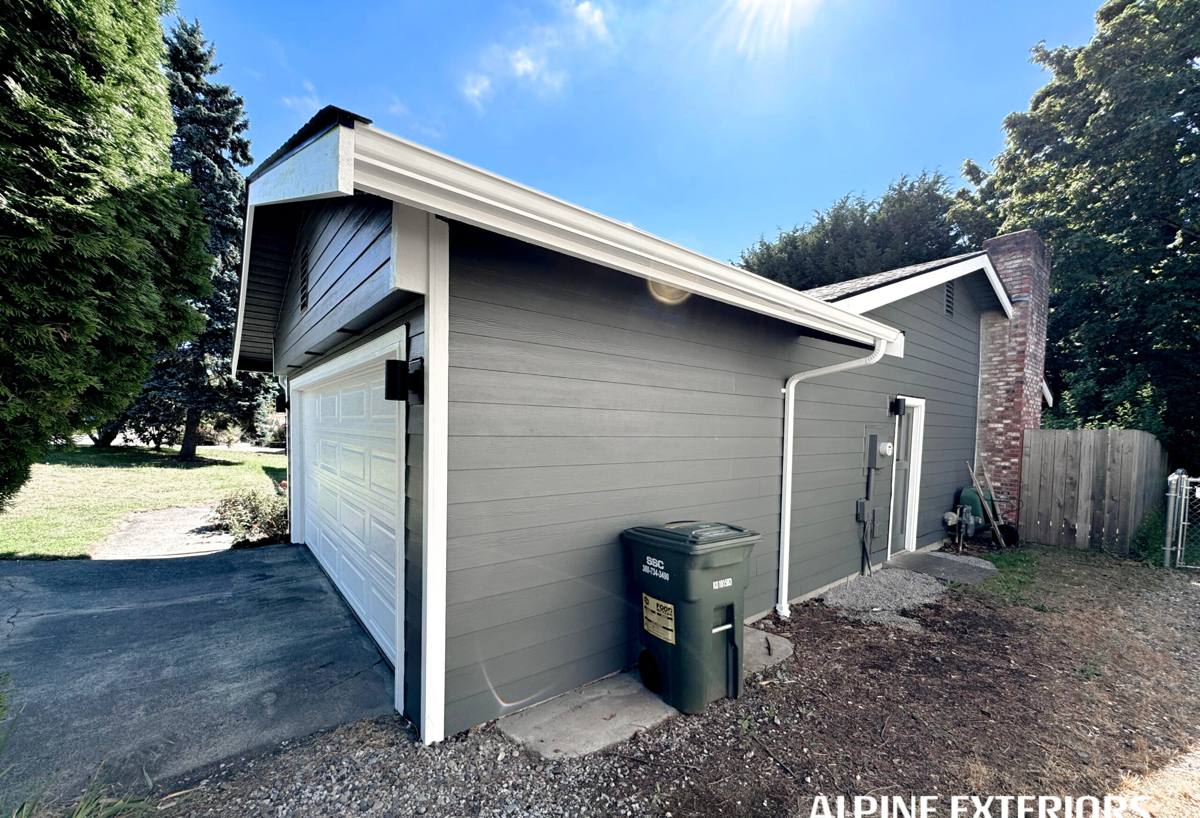
We standardized on James Hardie fiber cement for every job we do, including here in Columbia, and we're upfront about why. Hardie board is non-combustible, dimensionally stable across wet-dry cycles, and finished at the factory with ColorPlus technology — a baked-on finish that holds color and resists the fading and chalking that field-applied paint eventually shows. That factory finish matters more in a salt-air environment, where paint film breaks down faster than it does inland.
We don't install LP SmartSide, vinyl, Cemplank, Allura, or bare cedar or spruce siding. That's not a knock on every homeowner who has one of those products — plenty of houses in Bellingham have vinyl or wood siding that's been maintained well. It's a statement about what we're willing to warranty our labor against. Vinyl expands and contracts significantly with temperature swings and can crack or bow in a wind event; engineered wood products depend heavily on paint film integrity to keep moisture out and can swell at cut edges if that film is compromised; bare wood needs a maintenance cycle most homeowners don't keep up with once the excitement of a new siding job wears off. Fiber cement, installed correctly, removes most of that maintenance burden.
What Hardie Gets Right for This Area
- Non-combustible core — doesn't feed a fire the way wood-based products can
- Moisture-stable — doesn't swell, rot, or delaminate the way engineered wood or untreated cedar can
- Factory ColorPlus finish — holds up to UV and salt air far longer than field-applied paint
- HZ5 formulation — Hardie's cold- and moisture-climate product line, engineered for regions like ours
- Transferable warranty — backed by the manufacturer, not just our own workmanship guarantee
What a Correct Installation Involves Here
James Hardie siding is only as good as the water management system behind it, and that's where most siding failures actually start — not in the board itself, but in flashing, house wrap, and joint details that let water behind the cladding. For a home in Columbia, we pay particular attention to a few things that matter more here than they would in a drier climate:
Water Management Behind the Boards
- Correctly lapped weather-resistant barrier (house wrap) with all seams taped, so wind-driven rain can't track behind the siding
- Rainscreen or drainage gap where the wall assembly calls for it, letting any incidental moisture drain and dry instead of sitting against the sheathing
- Properly flashed windows, doors, and any wall penetrations — the single most common point of water intrusion on any home
- Corrosion-resistant fasteners and trim hardware, since standard fasteners degrade faster in salt-air exposure
Cutting, Fastening, and Finishing
- Factory-primed cut edges sealed in the field per Hardie's published instructions — an exposed cut edge is a moisture entry point
- Correct nail spacing and fastener depth, since over-driven or under-driven fasteners both cause problems over time
- Caulking and sealants matched to Hardie's specifications, not just whatever's on the truck
- Proper clearance from grade, roof lines, and decks so the board never sits in standing water or gets sprayed by a sprinkler system
Skipping any one of these doesn't usually cause an immediate problem — it causes a slow one. That's part of why so much siding damage in wetter regions gets discovered years after the original installation, once it's already expensive to fix.
Moss and Algae: The Slow Damage Nobody Notices
Moss season in Whatcom County isn't just cosmetic. Moss and algae growth on siding hold moisture against the wall surface for extended periods, which on a poorly detailed installation can eventually work its way into seams, trim joints, or fastener penetrations. On Hardie siding installed correctly, moss growth is mainly a cleaning issue — a soft wash removes it without damaging the factory finish. On products where the finish is thinner or more porous, the same moss growth can accelerate finish breakdown and, over years, moisture intrusion.
We can't stop moss from growing in a shaded, damp neighborhood — that's a fact of the local climate, not a siding defect. What correct installation and product choice do is make sure moss stays a surface-level maintenance item instead of turning into a structural or moisture problem.
Comparing Siding Approaches for a Columbia Home
| Factor | James Hardie Fiber Cement | Vinyl | Engineered Wood (LP-type) |
|---|---|---|---|
| Salt air resistance | Strong — factory finish holds up well | Fair — can become brittle over decades | Depends heavily on paint film condition |
| Wind-driven rain tolerance | Strong with correct flashing/water management | Moderate — seams can allow water intrusion | Moderate — edges vulnerable if finish fails |
| Moss/algae impact | Cosmetic — cleans off factory finish | Cosmetic, but can trap moisture at seams | Can accelerate edge swelling if not addressed |
| Fire behavior | Non-combustible core | Melts/deforms under heat | Combustible, wood-based core |
| Typical maintenance | Occasional wash, minimal repainting | Occasional wash, no repainting | Periodic repainting/caulking to protect edges |
This isn't meant to declare every alternative product unusable — it's meant to explain, honestly, why we made the call we did for the climate we work in.
Our Process for a Columbia Job
Every job starts with a walk-around assessment of the existing wall assembly, not just a measurement for new boards. We're looking at current siding condition, any signs of past water intrusion, window and door flashing condition, and how the house is oriented relative to prevailing wind and rain direction — details that change our approach more in a coastal-influenced neighborhood like Columbia than they would elsewhere.
- On-site assessment of existing siding, trim, and water management details
- Written scope covering removal, house wrap and flashing repair or replacement, and Hardie product selection
- Installation following James Hardie's published fastening, clearance, and sealing specifications
- Final walkthrough covering care and cleaning expectations, including moss and algae maintenance
We also stand behind the work with our own workmanship warranty on top of Hardie's manufacturer warranty, which is transferable if you sell the home — something worth mentioning to a buyer's inspector down the road.
What This Typically Involves Cost-Wise
Every Columbia home is different — square footage, number of stories, existing siding removal, trim complexity, and how much flashing or sheathing repair is needed all move the number. Rather than quote a figure that won't match your house, we walk every job in person before giving a number, because a house with hidden water damage behind old siding needs a different scope than one that's just cosmetically dated.
What Moves the Price
- Home size and number of stories (access and staging complexity)
- Condition of the existing wall assembly once old siding comes off
- Amount of trim, window, and corner detail work
- Whether house wrap or flashing needs full replacement versus spot repair
- Hardie plank profile and ColorPlus color selection
Why Hiring a Crew That Already Works This Neighborhood Matters
Siding installation instructions are the same on paper everywhere Hardie sells its product, but the judgment calls — how much drainage gap to build in, where to add extra flashing attention, how to handle a wall that already shows past moisture staining — come from having installed in this specific climate repeatedly. A crew that mostly works drier inland areas may not default to the same water-management habits that Bellingham Bay's climate demands. Local experience with salt air, wind-driven rain patterns, and moss behavior isn't a marketing line — it changes small decisions on the job that affect how the siding performs ten or twenty years from now.
If you're weighing a siding replacement or repair in Columbia, we're happy to come take a look, walk you through what we're seeing on your specific home, and give you a straightforward, no-pressure estimate. There's no cost or obligation to have us out — fill out the form below to get started.