 Bellingham Siding
 Why Birch Bay's Climate Is Hard on a Roof
Birch Bay sits right on the water in Whatcom County, close enough to the Canadian border that the same marine weather patterns that shape Bellingham's climate hit here even harder. The bay is more exposed than town — less tree break, more open shoreline — so wind-driven rain comes in sideways during fall and winter storms instead of just falling straight down. That matters for roofing because most roof systems are designed to shed water moving downhill, not water being pushed sideways and upward under laps, flashing, and shingle edges.
Add in the salt air off the Salish Sea, and you've got a slow, steady corrosion process working on every exposed metal component on the roof — nail heads, flashing, gutter hangers, vent caps. None of that shows up overnight. It shows up as a small leak two or three winters later, usually right where a homeowner never thought to look.
Then there's moss. Whatcom County's damp, mild winters and the shaded, wooded lots common around Birch Bay create a moss season that runs long, often from fall through spring. Moss doesn't just look bad; it holds water against the roof surface and works its way under shingle tabs, which is one of the most common repair calls we get in this area.
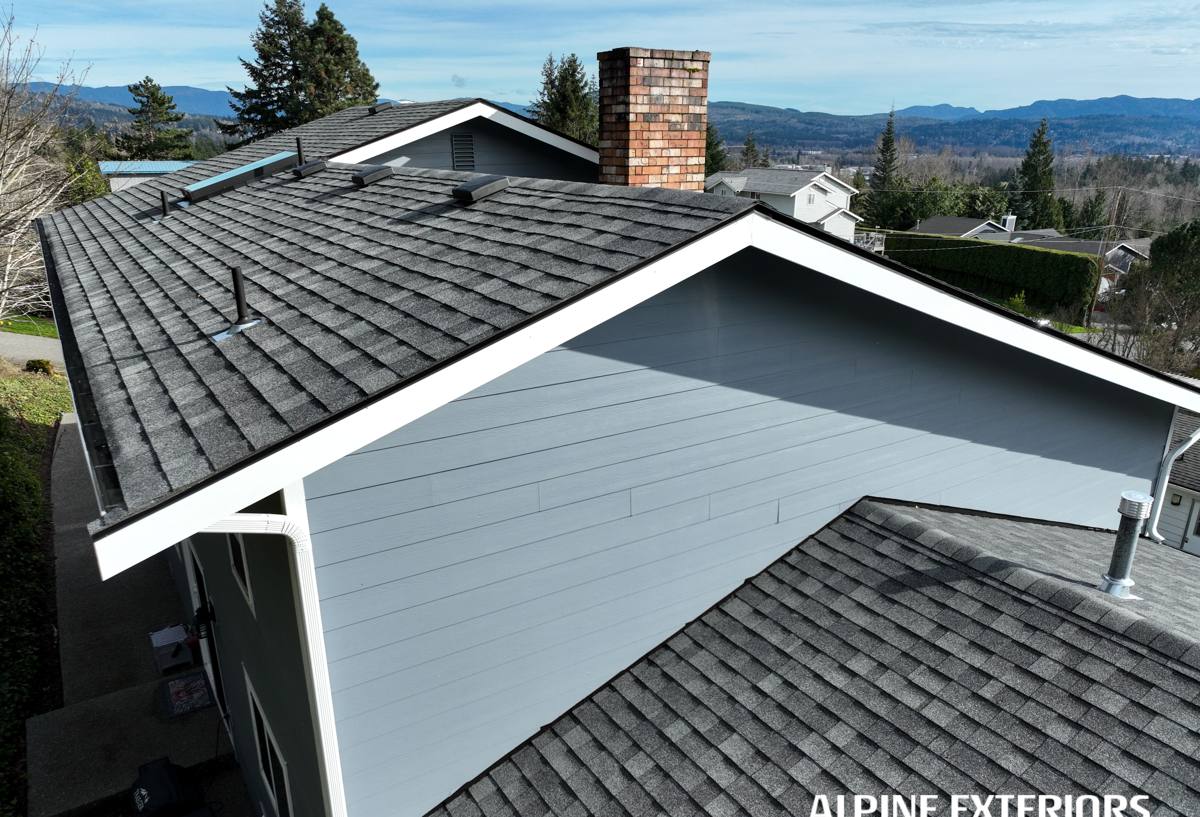
The Repairs We See Most Often Out Here
Every coastal neighborhood has its own repair pattern, shaped by wind exposure, tree cover, and how homes are built and used. In Birch Bay, four issues account for most of the repair calls we run.
Flashing Failures
Flashing — the metal or rubberized material that seals transitions at chimneys, skylights, sidewalls, and valleys — fails more often than the shingles around it. It's the single most common source of a "mystery leak" that shows up as a stain on an interior ceiling nowhere near where the water is actually entering. Wind-driven rain is especially hard on flashing because it pushes water uphill and sideways into laps that were only ever designed to handle water flowing straight down.
Moss and Algae Damage
On shaded or north-facing slopes, moss takes hold in the granule layer of asphalt shingles and lifts the tabs as it grows, breaking the seal between courses. Once that seal is broken, wind-driven rain has a direct path underneath. Left alone through a full moss season, this turns from a maintenance issue into a repair — and eventually a replacement — issue.
Wind and Storm Damage
Because Birch Bay is more exposed to open water than a lot of in-town Bellingham lots, roofs here take more direct wind loading during fall and winter storms. Ridge caps, exposed shingle tabs along rakes and eaves, and older or already-weakened shingles are usually what give first.
Salt-Air Corrosion
Galvanized fasteners, thinner flashing metal, and unprotected gutter hardware corrode faster this close to saltwater than they would a few miles inland. A nail that backs out because its head has corroded away is a very common, very fixable repair — if it's caught before the hole it leaves has let water into the decking underneath.
Repair or Replace? How We Make the Call
Not every roof problem in Birch Bay needs a full replacement, and we don't sell one when a repair will hold up. The honest answer depends on the roof's age, how widespread the damage is, and what's actually happening underneath the surface layer.
| Situation | Repair usually makes sense | Replacement usually makes sense |
|---|---|---|
| Age of roofing | Under 15–18 years, most materials | At or past the manufacturer's expected service life |
| Extent of damage | Isolated to one slope, valley, or penetration | Spread across multiple slopes or the whole roof |
| Decking condition | Solid, dry decking under the damaged area | Soft, delaminated, or stained decking found during inspection |
| Moss/algae staining | Surface growth, seal still mostly intact | Widespread granule loss and lifted tabs across the field |
| History of leaks | First occurrence, one clear cause | Recurring leaks in different spots, patch history |
We walk the roof, not just eyeball it from the ground, before we tell a homeowner which side of that table they're on.
What Repairs Typically Cost
Exact pricing depends on what we find during inspection, but homeowners planning ahead deserve an honest sense of scale rather than a vague "it depends." These are broad, general ranges for common Birch Bay repair scenarios — not quotes.
| Repair type | General price range | What drives the cost |
|---|---|---|
| Minor flashing repair | Several hundred dollars | Access, number of penetrations, extent of surrounding damage |
| Moss removal and treatment | A few hundred to around a thousand dollars | Roof size, pitch, and how established the growth is |
| Localized shingle or wind damage repair | Several hundred to low thousands | Number of damaged shingles, matching material availability |
| Multi-point or valley leak repair | Higher end of the repair range | Number of leak sources, decking repair if intrusion has been ongoing |
Anything that starts creeping toward the cost of a full section replacement is usually a sign the roof has more going on than one isolated repair can fix — and we'll tell you that plainly rather than stack repairs on a roof that's telling you it's done.
What a Proper Repair Actually Involves
A repair done right starts with finding the actual source of the problem, not just the spot where water showed up inside the house. Water travels along decking and framing before it drips, so the visible stain and the entry point are often feet apart. A quick patch at the stain, without tracing the water back to where it's actually getting in, is one of the most common reasons a "fixed" leak comes back.
- Trace the leak from the interior evidence back to its likely origin on the roof.
- Inspect the roof surface, flashing, and penetrations in that area, plus anything uphill of it.
- Check the decking underneath for soft spots or rot before covering anything back up.
- Replace or re-seal the actual failed component — flashing, shingles, boots, or fasteners — rather than just caulking over the symptom.
- Match materials as closely as possible so the repair blends in and performs the same as the surrounding roof.
- Confirm the fix by checking it under conditions similar to what caused the original leak, when practical.
Skipping straight to the quick caulk-and-patch step is how the same leak comes back a year later somewhere close by.
Materials and Fasteners That Hold Up Near Saltwater
What goes into a repair matters as much as the workmanship, especially this close to the water. Our standard is to use materials rated for coastal exposure rather than whatever's cheapest at general supply, because the cost difference on a repair is small and the difference in how long it lasts is not.
| Component | Standard-duty option | Our preference for coastal exposure |
|---|---|---|
| Fasteners | Electro-galvanized | Hot-dip galvanized or stainless |
| Flashing metal | Bare or thin galvanized | Heavier-gauge or coated galvanized metal |
| Sealants | General-purpose caulk | Roofing-grade, UV- and moisture-stable sealant |
| Gutter hardware | Standard steel hangers | Corrosion-resistant hangers and fasteners |
None of this is exotic material — it's a matter of specifying the version built to handle salt air instead of defaulting to whatever's cheapest, and it's a big part of why some repairs last five years and others last fifteen.
Moss Season: What Actually Works Long-Term
Whatcom County's moss season is long, and Birch Bay's tree cover and dampness make it worse than drier, more open parts of the region. Killing moss with a one-time treatment doesn't fix the underlying problem — it comes back the next damp season unless the conditions that let it grow are addressed too.
A few things actually change the long-term picture: keeping overhanging branches trimmed back so the roof gets more sun and air movement, keeping gutters and valleys clear so water doesn't sit, and, where it fits the roof type, zinc or copper strips near the ridge that release trace metal ions with every rain to slow regrowth. None of this replaces removing moss that's already lifted shingles — that damage needs to be repaired, not just cleaned.
Signs It's Time to Call
Most roof repairs get cheaper and simpler the earlier they're caught. A short walk around the house a couple of times a year, especially after a big wind or rain event, can catch problems while they're still small.
- Granules collecting in gutters or at downspout outlets
- Shingle tabs that look lifted, curled, or out of line with the rest of a slope
- Visible moss or dark streaking, especially on shaded or north-facing sections
- Rusty streaks below flashing, vents, or fasteners
- Ceiling stains, especially ones that only appear during or right after a storm
- Daylight visible through the roof deck from inside an attic or crawlspace
- Missing or displaced ridge caps after a windstorm
Any one of these on its own doesn't necessarily mean a big problem, but it does mean it's worth a look before the next storm season.
Our Process, Start to Finish
We keep the process straightforward because most homeowners just want a clear answer and a fair price, not a sales pitch.
We start with an inspection of the roof itself, not just a guess from the ground or from photos. We explain what we find in plain terms, including whether we think a repair is the right call or whether we're seeing signs that point toward replacement — and we'll say so either way. If it's a repair, we give a clear, itemized estimate before any work starts. We do the work, clean up thoroughly, and stand behind what we install with a straightforward workmanship warranty on top of whatever the material manufacturer provides.
For the seasonal and vacation homes that are common around Birch Bay, we also coordinate scheduling with owners who aren't on-site full time, since a small leak in an empty house can go unnoticed a lot longer than in one where someone's home every day.
Why a Bellingham Crew That Already Works Birch Bay Matters
A roofing crew based in Bellingham that regularly works Birch Bay knows the difference between an inland roof and a shoreline one before they even climb the ladder — how much harder wind-driven rain hits an exposed slope out here, how much faster salt air eats through unprotected fasteners, and how long the moss season really runs on a wooded, damp lot this close to the water.
That local familiarity means fewer surprises during the inspection, a more accurate estimate the first time, and a repair built for the conditions this specific stretch of Whatcom County actually sees — not a generic fix that would hold up fine forty-five minutes inland but not here.
Storm damage also doesn't wait for a convenient time. A crew that's already working this area can usually respond faster after a bad windstorm than one dispatching from farther inland, and that matters when a tarp needs to go on before the next system rolls through, not next week.
If you're dealing with a leak, storm damage, or just want an honest read on where your roof stands, we're happy to take a look. Reach out for a free, no-pressure estimate using the form below.