 Bellingham Siding
 Why Birch Bay Roofs Wear Out Differently
Birch Bay sits right on the water, and that changes what a roof has to deal with compared to a home a few miles inland in Bellingham or Ferndale. The salt-laden air off the bay works on exposed metal — fasteners, flashing, gutter hardware — faster than it would in a drier or less coastal spot. Add in the driving rain that comes sideways off the water during winter storms, and any weak point in flashing or underlayment gets tested hard, repeatedly, for months at a time. Then there's the moss. Whatcom County's long, cool, wet season gives moss and algae a huge head start on any roof surface that holds moisture or sits in shade, and once moss gets a foothold under shingle tabs, it lifts them and lets water in underneath.
None of this means a roof in Birch Bay needs to be exotic or overbuilt. It means the details that get skipped on an easy job elsewhere — proper fastener selection, correct flashing laps, real ventilation — aren't optional here. A new roof installed without those details in mind will look fine for a year or two and then start showing problems that are expensive to trace back to the install.
What a Correct Installation Actually Involves
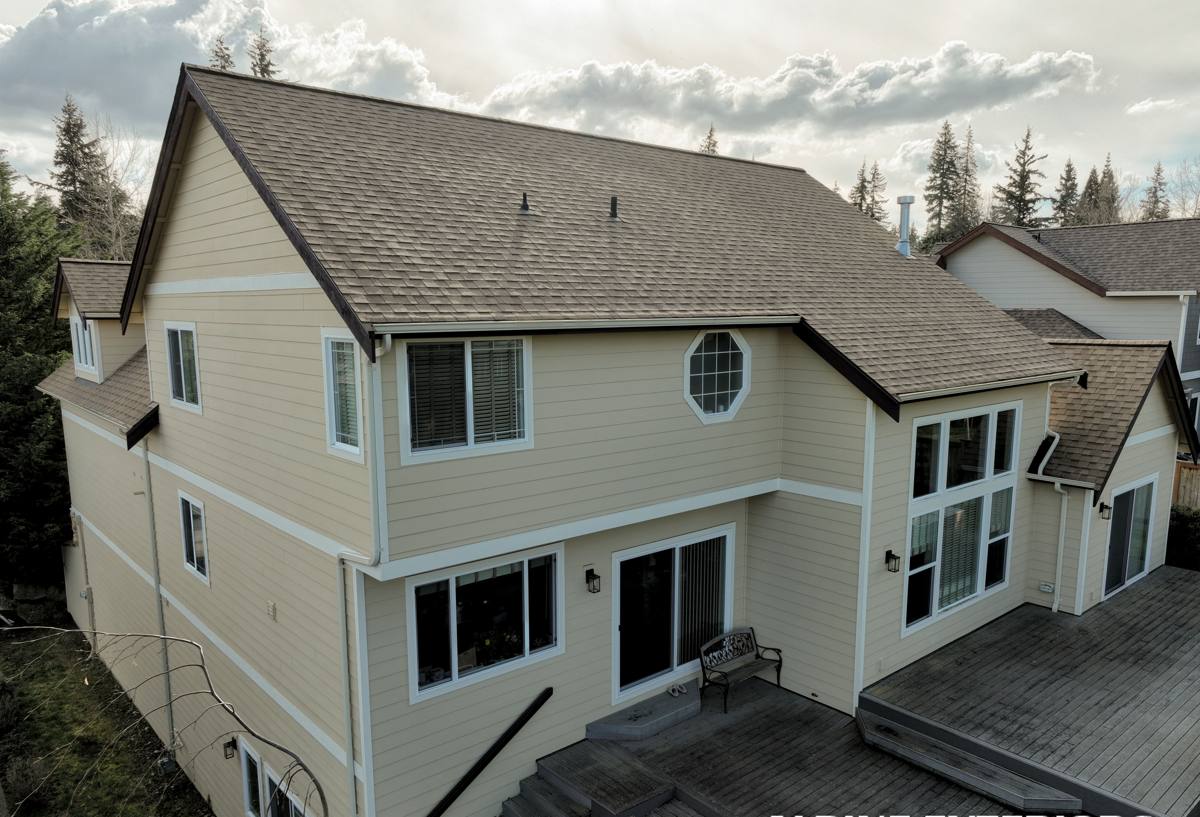
A new roof is more than shingles nailed to plywood. The parts you don't see are what determine whether the roof holds up through a decade of Whatcom County winters.
Decking and Structure First
Before anything goes down, the old roofing comes off and the deck gets inspected — not glanced at. Soft spots, delaminated plywood, or water-stained sheathing get replaced, not covered over. Skipping this step is the single most common shortcut in cheap roofing jobs, and it's invisible until the new roof starts sagging or leaking from the inside out.
Underlayment That Actually Handles Rain
In a climate with sustained, driving rain, felt paper alone isn't enough protection if wind-driven water gets under a shingle tab. A synthetic underlayment across the full roof, with self-adhering ice-and-water membrane at eaves, valleys, and any roof-to-wall transition, gives the roof a real second line of defense — because in Birch Bay, water will occasionally get past the primary surface, and the question is what's underneath it when it does.
Flashing and the Details That Cause Leaks
Almost every roof leak we trace back to installation error, not material failure, comes down to flashing: valleys, chimneys, skylights, and especially the spot where a roofline meets a sidewall. That last one needs proper kick-out flashing to direct water away from the wall assembly — a detail that's frequently left off or installed wrong, and one of the leading causes of hidden wall rot in older coastal homes in this region.
Ventilation: The Part Homeowners Never See
A roof that can't breathe traps moisture in the attic, and trapped moisture accelerates both rot on the underside of the deck and moss growth on top, because a warm, damp attic keeps the roof surface wetter longer after every rain. Balanced intake at the eaves and exhaust at the ridge isn't a luxury upgrade — it's part of what makes a roofing warranty meaningful in a climate this wet.
Comparing Roofing Materials for a Birch Bay Home
There's no single "best" roofing material — the right choice depends on your home's style, your budget, and how much long-term maintenance you're willing to take on. Here's how the common options compare for a coastal Whatcom County property:
| Material | Typical Lifespan | Moss/Algae Resistance | Salt Air Performance | Maintenance |
|---|---|---|---|---|
| Architectural asphalt shingle (algae-resistant) | 25–30 years | Good with granule treatment | Good with corrosion-resistant fasteners | Low to moderate |
| Standing seam metal | 40–50+ years | Excellent — sheds moss buildup | Very good with proper fastener/finish selection | Low |
| Synthetic composite shake/slate | 30–50 years | Very good | Good | Low |
| Cedar shake (natural wood) | 20–30 years | Poor without regular treatment | Fair — hardware needs care | High |
We're honest with homeowners about cedar shake specifically because it's the material most likely to disappoint in this climate. It looks great new, but untreated wood in a location with this much sustained moisture and moss pressure needs ongoing cleaning and treatment to avoid rot — it's a real maintenance commitment, not a failure of the product itself, just a mismatch with a wet coastal environment if you're not prepared to keep up with it. Metal and quality architectural asphalt tend to be the more worry-free choices for most Birch Bay homes.
Our New Roof Installation Process
- On-site inspection and estimate — we walk the roof and attic, check decking condition from what's visible, and measure for an accurate material quantity, not a rough guess.
- Material selection — we go over the tradeoffs in plain terms so you're choosing based on your budget and how the home will be used, not a sales script.
- Tear-off and deck inspection — full removal of old roofing, with any compromised sheathing replaced before anything new goes down.
- Underlayment and flashing installation — ice-and-water membrane at vulnerable points, synthetic underlayment across the field, and new flashing at every penetration and transition.
- Ventilation check and correction — intake and exhaust venting is verified and corrected if the existing setup is inadequate for the home.
- Roofing installation — installed to manufacturer specification, which is what keeps the material warranty valid.
- Cleanup and final walkthrough — magnetic sweep for nails, debris removal, and a walkthrough so you know exactly what was done and where.
Signs You Need a New Roof, Not Another Repair
Not every roof problem calls for full replacement, but in a climate that's hard on roofing, some signs mean patching is just delaying a bigger bill:
- Granule loss heavy enough that shingles look bald or patchy in several areas, not just one spot
- Multiple past repairs in different sections rather than one contained problem
- Moss established under shingle tabs rather than just on the surface — surface cleaning won't fix that
- Soft or spongy spots when walking the roof, which usually means deck damage underneath
- Daylight visible through the roof deck from inside the attic
- Shingles curling, cracking, or losing their seal, especially on rain- and wind-exposed slopes
- Interior ceiling stains that keep reappearing after repairs
What Drives the Cost of a New Roof in Birch Bay
Every roof is priced on its own specifics, but the main variables are consistent from job to job:
| Factor | Why It Matters |
|---|---|
| Roof size and pitch | More square footage and steeper pitches mean more material and labor time |
| Number of valleys, dormers, and penetrations | Each one needs custom flashing work, which adds labor |
| Deck condition | Rotted or delaminated sheathing has to be replaced before new roofing goes on |
| Material choice | Asphalt, metal, and composite products carry different material costs and install labor |
| Access and site conditions | Tree cover, steep lots, or limited staging space affect how efficiently a crew can work |
| Tear-off layers | Removing multiple existing layers of roofing takes more time and disposal cost than a single layer |
We give real numbers after an on-site look, not a phone estimate — roof pricing without seeing the deck condition and roof geometry is usually just a guess.
Why Hiring a Crew That Already Works Birch Bay Matters
A roofing crew that's worked coastal Whatcom County knows to spec corrosion-resistant fasteners and hardware without being asked, because they've seen what standard fasteners look like after a few winters of salt exposure. They know where moss tends to establish on a given roof orientation and design ventilation and material choice around it instead of treating moss as an afterthought cleaning problem. And they know how to detail a roof-to-wall intersection correctly, because that single detail is responsible for a disproportionate share of the hidden water damage we see in older homes throughout the Bellingham and Birch Bay area. That local pattern recognition is worth more than any brochure claim — it comes from doing this work in this specific climate, repeatedly.
Homeowner Checklist: Before and After a New Roof Install
- Before: confirm the contractor is inspecting the deck, not just quoting off the existing roof's surface appearance
- Before: ask specifically what fastener and flashing material will be used, given the coastal salt exposure
- Before: clarify how ventilation will be handled, not just what shingle brand is going on
- During: expect a magnetic nail sweep and daily debris cleanup, not a job site left messy overnight
- After: get the manufacturer warranty registration confirmation in writing
- After: ask for photos or notes on any deck repairs that were made, since those areas are now hidden
- Ongoing: plan on a roof check after major storms and before the wettest months, especially if trees overhang the roof
If your roof in Birch Bay is showing its age or you're planning ahead of the wet season, we're happy to take a look and give you a straightforward, no-pressure estimate — just fill out the form below.