 Bellingham Siding
 Barkley's Siding Challenge: Salt Air, Driving Rain, and a Long Moss Season
Homes in the Barkley area of Bellingham sit close enough to Bellingham Bay and the surrounding waterways that salt-laden air is a constant, low-grade stressor on exterior materials, even on properties that never look directly at the water. Add in the driving, wind-pushed rain that rolls off the Strait through much of the fall and winter, and a moss season that in Whatcom County can run eight months or longer on shaded and north-facing walls, and you have a climate that is genuinely hard on siding. It's not dramatic weather — no hailstorms or triple-digit heat — but it is relentless, and relentless moisture exposure is exactly what wears siding down from the inside before it ever looks bad from the street.
Barkley includes a mix of home ages and original siding types, and what we see repeatedly is that siding chosen for looks or cost at the time of construction often wasn't built for this specific combination of salt exposure, sustained dampness, and shade-driven moss growth. By the time problems show up on the surface, there's frequently already damage happening underneath.
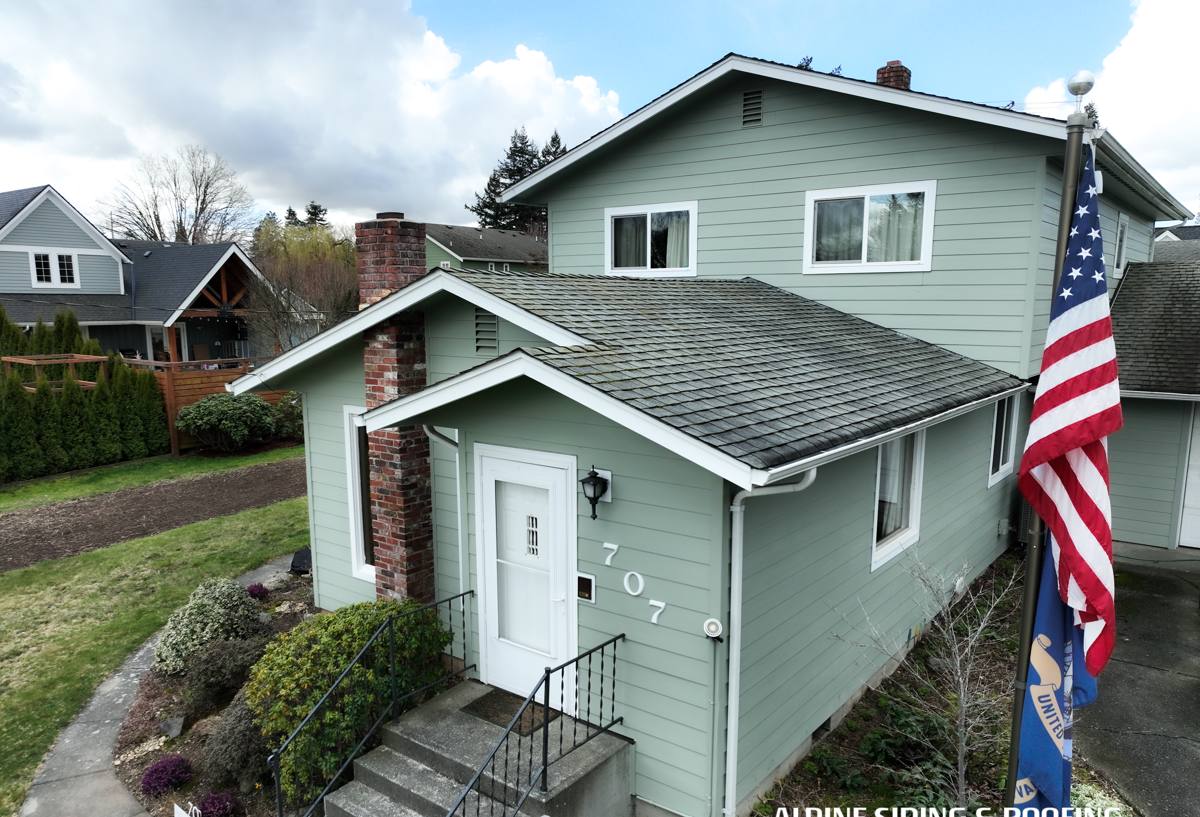
Signs a Barkley Home Needs Siding Replacement
Because moisture damage in this climate tends to start behind the siding rather than on top of it, homeowners often wait too long simply because the exterior still looks presentable from the curb. Here's what we tell Barkley homeowners to actually check for:
- Soft or spongy spots when you press on siding, especially near the bottom courses and around window and door trim
- Persistent moss or dark streaking on north- and west-facing walls that comes back within weeks of cleaning
- Paint that's bubbling, peeling, or needing repainting more often than every 7-8 years
- Visible gaps, warping, or cupping in individual boards or panels
- Rust staining around nail heads or fasteners, a sign of corrosion working from the outside in
- Musty smells or discoloration on interior walls that back up to exterior siding
- Siding that's original to a home built more than 20-25 years ago and has never been fully replaced
Any one of these on its own might just mean a repair. Several together, especially combined with age, usually means the siding system as a whole has reached the point where full replacement costs less over time than continuing to patch it.
What a Correct Siding Replacement Involves
Siding replacement done right is not just swapping old boards for new ones. In a climate like Bellingham's, the work that happens before and underneath the visible siding matters more than the siding itself.
Tear-Off and Sheathing Inspection
Once the old siding comes off, we inspect the sheathing and framing underneath for rot, soft spots, or prior water intrusion. This is the point where hidden damage from years of moisture exposure gets found and dealt with — patching or replacing damaged sheathing before anything new goes back up. Skipping this step, or not budgeting time for it, is how a siding job ends up covering a problem instead of fixing it.
Weather-Resistive Barrier and Flashing
A correctly installed weather-resistive barrier, properly lapped and sealed, along with correctly integrated flashing at windows, doors, and rooflines, is what actually keeps driving rain out of the wall assembly. Siding sheds most of the water, but flashing and the barrier behind it handle the water that gets past the siding — which, in this climate, is not a rare event.
Fastening and Finish to Manufacturer Spec
Fiber cement siding has specific fastening patterns, clearances, and caulking requirements that vary by climate zone. Installing to those specifications — correct nail placement, proper gaps at trim and butt joints, and the right sealants — is what preserves both the performance and the warranty coverage. This is also where a lot of lower-bid installs cut corners in ways that don't show up for a few years.
Why We Install Only James Hardie Fiber Cement
We install James Hardie fiber cement siding exclusively — no vinyl, no LP SmartSide, no Cemplank or Allura, no primed spruce or cedar. That's a deliberate standard, not a limitation of what we're able to install.
Fiber cement is non-combustible and dimensionally stable, meaning it doesn't expand, contract, or warp with moisture and temperature swings the way wood-based and some engineered wood products can. James Hardie's ColorPlus factory-applied finish is baked on under controlled conditions, which holds color and resists the fading and peeling that field-applied paint is prone to in a wet, low-sun climate. Hardie also engineers specific product lines (their HZ5 formulation) for regions with exactly the freeze-thaw and moisture exposure Whatcom County sees, rather than shipping one generic formulation everywhere. Combined with a strong, transferable manufacturer warranty, it's the product we're comfortable standing behind on a Barkley home for decades, not just for the first few years after installation.
Comparing Siding Materials for Barkley's Climate
Homeowners researching a replacement often ask how fiber cement stacks up against the other materials commonly used in the area. Here's an honest comparison based on how each performs under sustained coastal moisture and shade-driven moss growth:
| Material | Moisture Behavior | Maintenance | Fire Resistance | Typical Lifespan |
|---|---|---|---|---|
| James Hardie Fiber Cement | Dimensionally stable, doesn't swell or rot | Low — factory finish holds color | Non-combustible | 30-50+ years with correct install |
| Vinyl | Doesn't absorb water, but seams and gaps can trap moisture behind it | Low, but can crack or fade and isn't repairable in sections | Combustible, can melt or warp near heat | 20-30 years, fades over time |
| Cedar / Wood | Absorbs moisture, prone to rot and moss without diligent upkeep | High — regular sealing, staining, or painting | Combustible | 15-25 years without heavy maintenance |
| LP SmartSide (engineered wood) | Wood-based core is sensitive to sustained moisture exposure at cut edges and seams | Moderate — field-applied finishes need upkeep | Combustible | 20-30 years, install-sensitive |
Every material on that list has a legitimate use case somewhere. In a climate that combines salt air, sustained rain exposure, and long shaded moss seasons the way Bellingham does, fiber cement's stability and factory finish are what hold up best over the long run — which is the entire reason we standardized on it.
Our Process, Start to Finish
Barkley homeowners generally go through the same sequence with us, though the pace depends on the scope of the job:
- On-site inspection and honest assessment of whether the home needs repair, partial replacement, or full re-siding
- Product, profile, and ColorPlus color selection based on the home's style and any HOA or neighborhood guidelines
- Written estimate with a clear scope — no vague allowances for "surprises" once tear-off starts
- Tear-off, sheathing inspection, and repair of any damaged framing found underneath
- Installation of weather-resistive barrier, flashing, and new Hardie siding to manufacturer specification
- Final walkthrough and cleanup, with documentation for warranty registration
We don't start a job without knowing what's under the existing siding when we can reasonably find out in advance, and we don't finish one without walking the homeowner through exactly what was done.
Cost Factors for Barkley Siding Replacement
Every home is different, so we don't quote prices without seeing the house, but these are the factors that actually move the number:
| Factor | Why It Matters |
|---|---|
| Home size and wall complexity | More square footage and more corners, dormers, or gables mean more material and labor |
| Condition of sheathing underneath | Hidden moisture damage found during tear-off adds repair work before new siding goes up |
| Siding profile and trim detail | Lap width, shingle-style panels, and custom trim take more time than a simple plank layout |
| Number of stories and access | Multi-story walls and tight side-yards require more staging and time |
| Scope of accessory work | Replacing trim, fascia, or house wrap alongside siding adds to the total but reduces future issues |
The honest answer to "what will it cost" almost always requires an in-person look, which is exactly what a free estimate is for.
Why a Crew That Already Works in Barkley Matters
Siding performance in this climate comes down to details that are specific to how a house sits relative to sun, wind, and rain exposure — which walls stay damp longest, where moss takes hold first, and how driving rain off the bay hits a given orientation. A crew that has already worked on homes in and around Barkley has seen that pattern repeat across enough houses to know where to pay extra attention before problems start, not after. Familiarity with Bellingham and Whatcom County permitting requirements also keeps a project moving instead of stalling on paperwork. That local pattern-recognition is hard to substitute for, no matter how skilled an out-of-area crew is on the tools.
If your Barkley home's siding is showing its age, or you just want an honest read on whether repair or full replacement makes more sense, we're happy to take a look. Request a free, no-pressure estimate using the form below.