 Bellingham Siding
 Siding Repair Built for Barkley's Weather
Barkley sits close enough to the water and open enough to the wind that its homes take a specific kind of beating year after year. Driving rain off the Sound, salt-laden air, and a moss season that can stretch from October well into May all work on exterior siding in ways that homeowners further inland simply don't deal with. If you're noticing soft spots, peeling paint, staining, or panels that look swollen or warped, that's not cosmetic — it's a sign the siding is losing its fight with the climate, and it's worth understanding what's actually happening before you pay someone to patch it.
We've worked on homes throughout Bellingham and Whatcom County long enough to know that a repair done without accounting for local conditions usually fails again within a year or two. A repair in Barkley isn't the same job as a repair in a drier, more sheltered part of the county — the moisture load is higher, the exposure is often more direct, and the materials have to be matched to that reality.
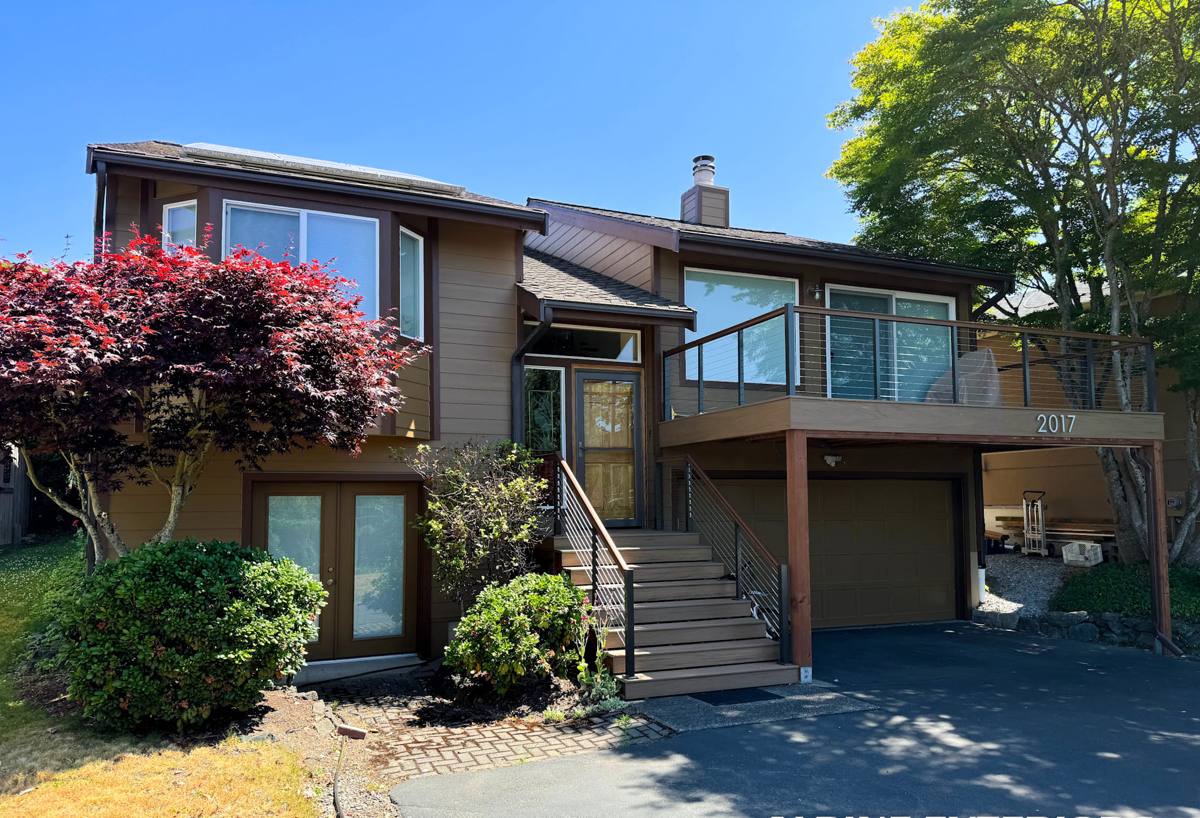
Why Siding Fails Faster Here
Salt Air and Corrosion
Proximity to salt water accelerates the breakdown of fasteners, flashing, and any siding material that isn't built to resist it. Salt air doesn't just affect metal — it also degrades certain paint finishes and lower-grade composite products faster than manufacturers' general climate ratings suggest, because those ratings are usually based on inland test conditions.
Driving Rain and Wind-Driven Moisture
Bellingham gets rain that doesn't fall straight down — wind pushes it sideways into wall assemblies, seams, and any gap in the water-resistive barrier. Over time this finds every weak point in a siding installation: unsealed butt joints, nail heads without proper caulking, undersized flashing, or house wrap that was installed with shortcuts. Once water gets behind the siding, the damage often starts on the sheathing before it's even visible on the surface.
Moss, Algae, and the Long Wet Season
Whatcom County's moss season is long, and shaded or north-facing walls in Barkley rarely get enough sun to dry out between storms. Moss and algae hold moisture against the siding surface for extended periods, which is hard on paint film, hard on caulking, and — on the wrong substrate — hard on the material itself. A repair that doesn't address the moisture-holding conditions around it (gutters, plantings, shade) will just grow moss again within a season or two.
What a Correct Repair Actually Involves
A lot of "siding repair" in this region is really just cosmetic patchwork — caulk over a crack, a fresh coat of paint over a stain, a replacement board that doesn't match the original water management. That kind of repair looks fine for a few months and then fails again, often worse than before, because the underlying moisture problem was never fixed.
A repair done right starts with diagnosis, not patching:
- Removing enough siding around the damaged area to see the sheathing and house wrap condition, not just the surface
- Checking for soft or delaminated sheathing, which means the water intrusion has been going on longer than the visible damage suggests
- Inspecting and correcting flashing at windows, doors, and any penetration near the repair area
- Confirming proper drainage plane and house wrap lap direction so water sheds outward, not into the wall
- Matching replacement siding material, thickness, and profile so the repair doesn't create a visible patch or a new weak seam
- Re-caulking and painting to the same standard as new installation, not a quick touch-up
Skipping any of these steps is how a $400 patch turns into a $4,000 sheathing replacement two years later.
Our Repair Process in Barkley
1. On-Site Assessment
We look at the damaged area and the areas around it — moss buildup, gutter performance, grading, shade patterns, and how the wind and rain typically hit that side of the house. Most siding failures we see have a clear cause once you look at the whole picture, not just the damaged board.
2. Honest Scope
We tell you what we find, including if the damage is more extensive than it looks from the outside. If sheathing needs to be replaced, we say so before starting, not after opening the wall and surprising you with a change order.
3. Repair or Recommend Replacement
Localized damage on an otherwise sound wall gets a proper section repair. If we find the siding is failing broadly — moisture damage in multiple areas, a product that was never suited to this climate, or an installation with systemic flaws — we'll tell you that repair is a temporary fix and explain what full replacement would look like instead. We'd rather lose a repair job than sell you a patch we know won't hold.
4. Material Matching
Where we're repairing existing James Hardie fiber cement siding, we match the exact plank profile, exposure, and finish so the repair is close to invisible. Where we're replacing damaged sections of a different material entirely, we'll talk through whether a partial Hardie replacement makes sense on that wall or whether it's better addressed as part of a future full re-side.
Why We Only Use James Hardie for Repair Work
We install exclusively James Hardie fiber cement siding — not vinyl, not LP SmartSide, not Cemplank, Allura, or unprimed wood. That standard applies to repair work too. When we're replacing a damaged section, we use Hardie board because it's engineered for exactly the conditions Barkley deals with: it doesn't absorb water like wood-based composite products, it's dimensionally stable in wet-dry cycling, and it carries a factory ColorPlus finish that holds up to UV and salt air far better than field-applied paint on a patch.
We won't install other materials as a "cheaper patch" because in this climate, a mismatched or lower-grade repair material tends to become the next failure point — moisture behaves differently at the seam between two different products, and that seam is often where the next leak starts.
Common Repair Scenarios We See in Barkley
| Symptom | Likely Cause | Repair Approach |
|---|---|---|
| Soft or spongy siding near the bottom of walls | Poor grading, splash-back, or failed flashing at the foundation line | Remove and inspect sheathing, correct drainage, replace with matched Hardie board |
| Persistent moss/algae staining on shaded walls | Low sun exposure, moisture retention, infrequent cleaning | Clean, treat, repair any softened boards, address shade/airflow where possible |
| Peeling or bubbling paint | Moisture trapped behind the paint film, often from a wood-based substrate | Assess substrate condition; repair or recommend replacement if wood is compromised |
| Cracked or warped boards near corners | Wind-driven rain intrusion at poorly flashed corners or trim | Correct flashing detail, replace boards with proper corner treatment |
| Visible gaps or separated caulk joints | Material expansion/contraction cycling, aging sealant | Re-seal with appropriate sealant rated for this climate, inspect behind joint |
Cost Factors for Barkley Siding Repair
Repair costs vary more than most homeowners expect, mainly because the visible damage rarely tells the whole story. The factors that actually drive cost are:
- Whether sheathing or framing needs replacement, not just siding
- How much of the wall needs to come off to properly tie in the repair
- Whether matching material is readily available for an older installation
- Access — second-story walls, tight side yards, and landscaping can add labor time
- Whether flashing and water management need correction, not just cosmetic patching
We give straightforward, itemized estimates and explain the "why" behind each line, not just a total number.
Why Local Experience Matters for This Job
A crew that mostly works drier, more sheltered areas of Whatcom County can miss the specific failure patterns that show up in a wind- and salt-exposed area like Barkley. We've repaired enough siding in Bellingham's coastal-influenced neighborhoods to recognize the difference between a one-off installation defect and a symptom of the broader climate stress this area puts on exterior materials. That matters because it changes the recommendation — sometimes the right answer really is a targeted repair, and sometimes telling you that a repair won't hold is the more honest answer, even if it's not the one that gets us hired that day.
When Repair Isn't Enough
Not every damaged wall needs full replacement, but some do. If moisture damage shows up in multiple areas of the house, if the existing siding material was never well-suited to this climate, or if the installation has systemic issues (missing flashing details, poor house wrap laps, inadequate fastening), patching one section just delays the next failure. We'll always tell you honestly where your home falls on that spectrum rather than defaulting to whichever job is bigger.
If you're dealing with damaged, stained, or failing siding on your Barkley home, we're happy to take a look and give you a straight answer about what it needs. Reach out for a free, no-pressure estimate — we'll assess the damage, explain what we find, and let you know honestly whether repair or replacement is the right call.