 Bellingham Siding
 Why Barkley Roofs Wear Out on Their Own Timeline
Barkley is one of Bellingham's newer planned neighborhoods, with a mix of homes built from the late 1990s onward. That newer construction doesn't mean the roofs are exempt from what Whatcom County weather does to a house. If anything, the combination of factors here — moist air moving in off Bellingham Bay, the tree cover around the Lake Whatcom side of the neighborhood, and long stretches of mild, wet winter weather — can wear a roof down in ways that aren't always obvious from the ground.
Three things drive most of the roof replacement calls we get from this area: salt-laden air corroding metal components faster than inland roofs see, driving rain that finds its way into flashing and edge details that were installed a little too casually, and a moss season that runs long enough to hold moisture against shingles for months at a stretch. None of these are dramatic, one-time events. They're slow, cumulative, and they show up as a roof that's failing five or ten years earlier than the shingle warranty promised.
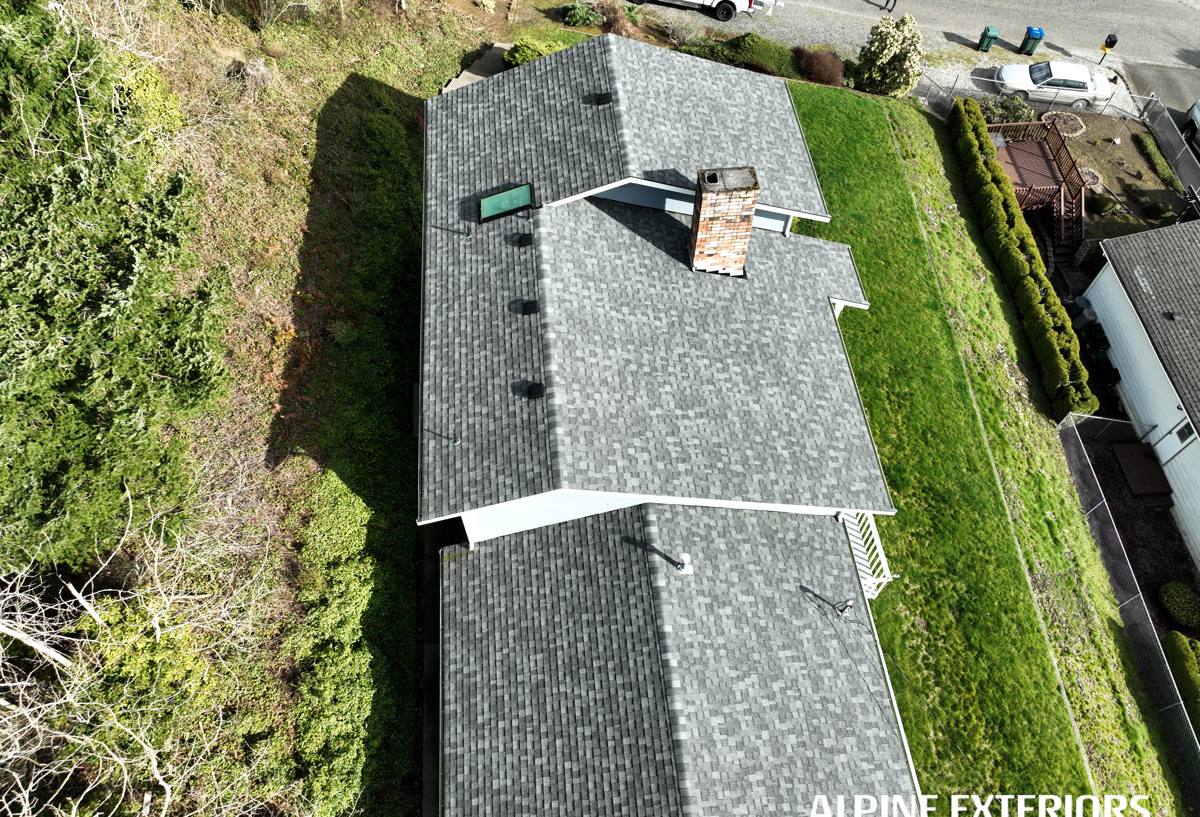
Signs a Barkley Roof Is Telling You Something
Most homeowners don't get a dramatic leak as their first warning sign. The real signals are quieter, and they're worth walking your property to check for a couple of times a year, especially heading into fall.
- Granules collecting in gutters or at the base of downspouts — a sign the shingle surface is wearing thin
- Dark streaking or green-black staining, especially on north-facing slopes that stay shaded and damp longer
- Moss clumps thick enough that you can see them lifting shingle edges rather than just sitting on the surface
- Curling, cupping, or cracked shingles, particularly on slopes that catch the most wind-driven rain
- Soft spots in the decking you can feel underfoot in the attic, or daylight visible around vent stacks and chimney flashing
- Rusted or corroding flashing, fasteners, or vent caps — more common here than in drier inland climates because of the salt content in the air
- Interior ceiling stains, musty attic smell, or insulation that feels damp even without an active leak
Any one of these on its own might just mean a repair. Several at once, or a roof that's already past 20-25 years old, usually means it's time to start planning for a full replacement rather than patching around the edges.
What a Correct Roof Replacement Actually Involves
A roof replacement is more than stripping old shingles and nailing down new ones. In a climate that gets sustained wet weather like Whatcom County does, the parts of the job that don't show from the street are usually what determine whether the new roof lasts 12 years or 30.
Tear-Off and Deck Inspection
We remove the old roofing down to the deck rather than layering over it. That's the only way to actually see what's underneath — soft or delaminated plywood, old water staining, or framing that's been quietly absorbing moisture for years. Any damaged decking gets replaced before anything new goes down. Skipping this step is the single most common shortcut that leads to a roof failing early, because a new roof over a compromised deck doesn't have anything solid to hold onto.
Underlayment and Ice/Water Protection
In a region that sees as much driving rain as this one does, the underlayment matters almost as much as the shingle itself. We use a synthetic underlayment as the primary water barrier, with self-adhering membrane at vulnerable points — eaves, valleys, around chimneys and skylights, and anywhere wind can drive rain up under the shingle edge instead of straight down.
Flashing and Penetrations
Flashing failure is behind most of the leaks we get called out to fix on roofs that are otherwise in decent shape. Every chimney, vent pipe, skylight, and wall intersection gets new flashing during a replacement — not just caulk over the old metal. Given the salt content in the air this close to the water, we pay attention to flashing material choice here specifically, since some metals corrode faster than others in a marine-influenced climate.
Ventilation
A roof deck that can't breathe traps moisture from inside the house, which shows up as premature shingle failure, mold, and rot from the underside — often before there's any sign of a problem from outside. Balanced intake and exhaust ventilation is part of a correct replacement, not an upsell.
Choosing a Roofing Material for Barkley's Climate
Most Barkley homes end up on asphalt shingles for good reason — solid performance for the cost, wide style range, and straightforward warranty coverage. But it's worth understanding the trade-offs before you pick a material, especially with this much moss pressure and rain exposure.
| Material | Typical Lifespan | How It Handles This Climate | Relative Cost |
|---|---|---|---|
| Architectural asphalt shingle | 25-30 years | Good moisture resistance with proper underlayment; needs periodic moss treatment | $ |
| 3-tab asphalt shingle | 15-20 years | Thinner profile wears faster under sustained damp conditions | $ |
| Metal (standing seam) | 40-50+ years | Sheds moss and moisture well; needs corrosion-resistant fasteners near the bay | $$$ |
| Cedar shake | 20-30 years with upkeep | Attractive but requires real maintenance discipline to resist rot and moss in a wet climate | $$$ |
| Synthetic composite | 30-50 years | Resists moisture absorption well; higher upfront cost, low maintenance | $$-$$$ |
We don't install every product on this list on every job. Cedar shake, for example, can look great, but it demands a maintenance routine most homeowners underestimate going in — regular cleaning, treatment, and inspection to keep moss and rot at bay in a climate this wet. If a homeowner wants shake, we'll install it correctly and explain what the upkeep actually looks like rather than letting the appeal of the material outrun the reality of maintaining it here.
Our Roof Replacement Process
- On-site inspection. We walk the roof, check the attic from the inside, and look at flashing, ventilation, and deck condition — not just the shingle surface.
- Written estimate. You get a clear scope of work and price before anything is scheduled, including what materials are being used and why.
- Material selection. We talk through the options above based on your budget, the slope and shading of your specific roof, and how much moss pressure that side of the house sees.
- Tear-off and deck repair. Full removal of old roofing, replacement of any compromised decking, and disposal handled as part of the job.
- Underlayment, flashing, and ventilation installed correctly. This is where most of the long-term performance is decided.
- New roofing installed to manufacturer specification, which is what keeps the material warranty valid if you ever need it.
- Final walkthrough. We go over the finished roof with you, including basic maintenance expectations for this climate.
Why It Matters That We Already Work in Barkley
Roofing crews that mostly work drier inland areas sometimes underbuild for what this side of Whatcom County actually deals with — less underlayment overlap, standard fasteners instead of corrosion-resistant ones, minimal attention to moss-prone shading. A crew that's already worked roofs in Barkley and the surrounding Bellingham neighborhoods knows which slopes on which style of home tend to hold moss longest, which flashing details fail first in wind-driven rain off the bay, and how to price a job accurately for this area instead of guessing from a regional average. That familiarity shows up in fewer callbacks and a roof that actually performs the way it's supposed to for the length of its warranty.
Keeping a New Roof Performing Longer in a Moss-Heavy Climate
A correct installation is the foundation, but a little seasonal attention extends the life of any roof in this climate significantly.
- Clean gutters and downspouts at least twice a year — clogged gutters back water up under the shingle edge
- Have moss treated before it establishes thick growth, not after it's already lifting shingles
- Trim back overhanging branches where practical to reduce shading and debris buildup on the roof surface
- Check attic ventilation isn't blocked by insulation, especially after any attic work or upgrades
- Schedule a roof inspection every couple of years, particularly after a hard windstorm off the water
- Address small flashing or fastener issues immediately rather than waiting for an active leak
What Roof Replacement Typically Costs
Every roof is different, and a real number only comes from an on-site look at your specific roof's size, pitch, layers, and condition. That said, homeowners planning ahead should know that cost is driven by a handful of factors more than by the brand name on the shingle bag.
| Cost Factor | Why It Matters |
|---|---|
| Roof size and pitch | Steeper roofs take longer to work safely and use more material per square |
| Number of layers to remove | Tearing off two or three old layers costs more in labor and disposal than one |
| Deck condition | Rotted or soft decking found during tear-off adds material and labor to replace |
| Material choice | Asphalt, metal, and composite options span a wide price range, as shown above |
| Roof complexity | Valleys, dormers, skylights, and chimneys all add flashing work and labor time |
| Access and slope | Roofs with difficult access or very steep pitches require more safety equipment and time |
Broadly speaking, a straightforward asphalt shingle replacement on an average Barkley home runs into the mid-to-upper five figures, with metal or composite roofing costing more upfront in exchange for a longer service life. We'd rather walk your roof and give you real numbers than have you plan around a generic estimate that doesn't reflect your actual roof.
If your roof is showing its age, or you just want an honest read on how much time you've got left before replacement becomes urgent, we're happy to take a look. The estimate is free, there's no pressure attached to it, and you'll get a straight answer either way — just fill out the form below.