 Bellingham Siding
 Why Sudden Valley Homes Wear Out Siding Faster Than You'd Expect
Sudden Valley sits in a heavily wooded, lake-adjacent pocket of Whatcom County, and that setting is beautiful right up until you look closely at the north and east walls of a house that's been up for fifteen or twenty years. Tall conifers block the sun on large stretches of most lots for much of the day. Combined with the long, wet Pacific Northwest rain season, that shade means siding here dries out slower than it does on an open lot in town. Slow-drying siding is exactly the condition that lets moss, algae, and wood rot get a foothold.
We're not describing a coastal salt-air problem in the way a beachfront property in some parts of Whatcom County deals with it — Sudden Valley is set back from open saltwater. The bigger local enemy is sustained moisture: driving rain off the lake, tree canopy that keeps walls damp longer after a storm, and a moss season that, on shaded siding, can run most of the year instead of just winter. Any siding material installed here has to handle repeated wet-dry cycling and stay dimensionally stable while damp, not just look good on a dry install day.
What This Means for Your Walls
- North- and east-facing walls under tree cover typically show moss and mildew first — often years before south-facing walls
- Ground-level siding near planting beds and sloped, wooded lots stays wetter longer after rain
- Gaps in caulking, flashing, or clearance become an entry point for moisture that has nowhere to evaporate quickly in a shaded microclimate
- Paint and coatings on wood-based products break down faster under repeated damp cycles, accelerating the maintenance clock
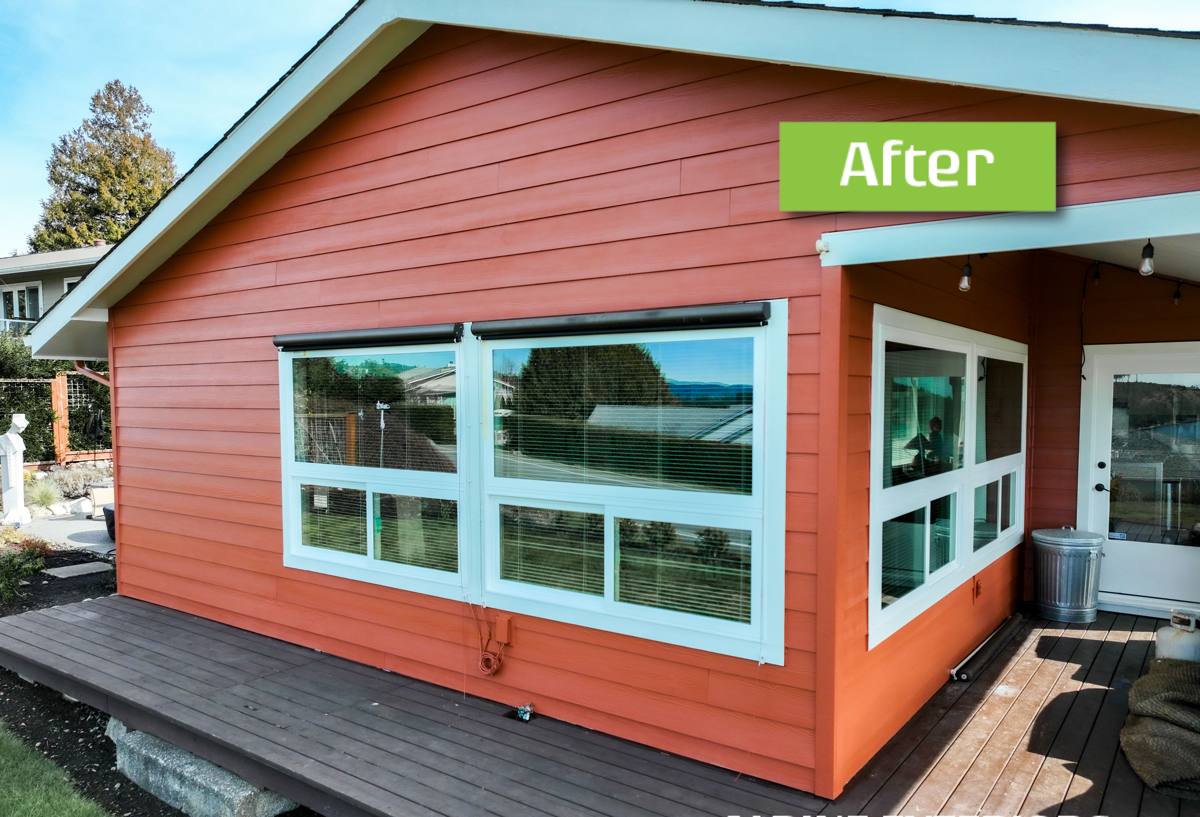
Why Fiber Cement Is the Right Material for This Environment
Fiber cement is cement, sand, and cellulose fiber, not wood. It doesn't swell, rot, or delaminate the way solid wood or wood-based composite siding can when it stays damp for extended stretches, which is precisely the condition Sudden Valley's shaded lots create. It's also non-combustible, which matters in a wooded community where wildfire risk in Western Washington's dry summer stretches has become a more common conversation than it used to be.
We install James Hardie fiber cement exclusively — not other fiber cement brands, not vinyl, not LP SmartSide, not primed wood, and not cedar. That's a deliberate standard, not a sales pitch. Hardie's ColorPlus factory finish is baked on and warranted against fading and peeling in a way field-applied paint isn't, which matters more here than in a sunnier climate because a lot of Sudden Valley siding never fully dries between coats of weather. Hardie also engineers its HZ5 product line specifically for regions like ours that see more moisture and freeze-thaw cycling than the deep South, where most fiber cement is sold.
How Fiber Cement Compares in This Setting
| Material | Behavior in shade/moisture | Moss & algae resistance | Maintenance burden here |
|---|---|---|---|
| James Hardie fiber cement | Dimensionally stable when wet or dry | Factory finish resists growth; occasional gentle wash needed | Low |
| Vinyl siding | Can warp/buckle with heat-cold cycling; seams trap moisture | Grows moss/algae readily in shade, especially at seams | Moderate, and damaged panels are hard to color-match years later |
| Cedar or primed wood | Absorbs moisture, slow to dry under canopy | Prone to moss, mildew, and rot in shaded, wet zones | High — repainting/staining on a recurring cycle |
| Engineered wood (LP SmartSide) | Resin-treated but still wood-based; edge/seam moisture intrusion is the known failure point | Better than raw wood, still susceptible at damaged or unsealed edges | Moderate to high, with strict caulking/paint maintenance required |
What a Correct Fiber Cement Installation Actually Involves
Fiber cement's reputation rides entirely on installation quality. A well-made product installed wrong will fail early, and in a climate like ours, "wrong" shows up faster than it would somewhere dry. There's no substitute for doing the fundamentals right.
Clearance and Drainage
Hardie's own installation instructions call for minimum clearances above roof lines, decks, patios, and grade — typically 6 inches from grade and 1-2 inches from roofing, depending on the detail. On sloped, wooded Sudden Valley lots where landscaping and grade often creep up over the years, we check and correct clearance rather than butt siding tight to whatever's there. A weather-resistive barrier and properly lapped, code-compliant flashing behind the siding give bulk water a way out instead of a way in.
Fastening and Joints
Fiber cement needs to be fastened per manufacturer spec — correct nail type, spacing, and depth — not overdriven, which cracks the material's edge and creates a moisture entry point that's invisible until the wall starts showing damage years later. Butt joints get flashed or sealed per Hardie's documented details, not just caulked and hoped for.
Caulking and Finish
Every seam, corner, and penetration (hose bibs, light fixtures, vents) gets sealed with a high-quality, paintable, exterior-grade sealant rated for our wet climate — and check-listed, not eyeballed. On ColorPlus panels, only touch-up matched to the factory finish goes on cut edges; we're not repainting the whole wall.
Our Process for Sudden Valley Projects
The steps are straightforward, but each one exists because we've seen what happens when it gets skipped.
- Site walk and estimate. We look at tree cover, grade, existing moisture damage, and access — a wooded, sloped lot changes staging and scaffolding needs compared to a flat, open one.
- Scope and product selection. We spec the correct Hardie plank, panel, or shingle profile and ColorPlus color, and note any trim, fascia, or soffit work that should happen at the same time.
- Tear-off and inspection. Removing the old siding is when hidden rot, missing flashing, or a compromised weather barrier gets found — and fixed — before new siding goes up over it.
- Weather barrier, flashing, and install. Correct clearances, fastening, and flashing details, checked as we go rather than only at the end.
- Final walkthrough and warranty registration. We register the installation with Hardie so the manufacturer's transferable warranty is actually in force, and we walk the job with you before calling it done.
What Sudden Valley Siding Projects Tend to Cost
Every home is different, and we won't quote a number without seeing the house, but these are the variables that actually move the price on a Sudden Valley job.
| Cost factor | Why it matters here |
|---|---|
| Access and staging | Sloped, wooded, or narrow-access lots take longer to scaffold and stage material safely |
| Existing damage found at tear-off | Shaded walls with years of moisture exposure sometimes need sheathing or framing repair before new siding goes on |
| Siding profile and trim complexity | Multiple gables, dormers, or a mix of lap and shingle-style Hardie adds labor time |
| Color and product line | Standard ColorPlus colors vs. custom-order options can affect lead time and price |
| Tear-off and disposal | Removing old wood, vinyl, or LP siding and hauling it off is a separate line item from the new install |
Questions Worth Asking Before You Sign Anything
- Is the crew installing per James Hardie's published fastening, clearance, and flashing specs, or working from general habit?
- Will the installation be registered with Hardie so the warranty is actually active?
- What happens if hidden rot or moisture damage is found once old siding comes off?
- Is the bid itemized enough to see tear-off, repair, and install as separate costs?
- Does the crew have experience on wooded, sloped, or limited-access lots like the ones common in Sudden Valley?
Living With Fiber Cement Siding in a Wooded, Wet Setting
Correctly installed Hardie siding is genuinely low-maintenance, but "low" isn't "none," especially under tree cover. A gentle rinse with a garden hose once or twice a year on shaded walls keeps moss and pollen from building up before it stains the finish. Avoid pressure washing directly into seams or at close range — it can force water past caulking that's otherwise doing its job. Keep gutters clear so water isn't sheeting down the wall face, and keep landscaping trimmed back from the siding so air can actually reach it and dry it out between rains. None of this is unique to Hardie, but it matters more in a shaded, lake-adjacent setting than it would on an open, sunny lot.
Why Local Experience in Sudden Valley Matters
A crew that's worked Sudden Valley before already knows the practical realities: private, sometimes narrow community roads that affect how material gets delivered and staged; sloped, tree-lined lots that change how scaffolding and safety gear get set up; and a moisture pattern that's different from siding a flat, open lot elsewhere in Whatcom County. That experience shows up in fewer surprises mid-project and a job that's planned around the actual site instead of a generic assumption about what a "typical" Bellingham-area home looks like. It also means we've seen how Hardie siding ages on homes in this specific setting over years, not just on install day.
If you're weighing a siding replacement on a Sudden Valley home, we're glad to walk the property, look at what your current siding is telling you, and put together a straightforward, no-pressure estimate — no obligation, just an honest look at what the house needs. Use the form below to get started.